This guide looks at what the goal actually means, what the data says about our progress and gaps, and gives you a free simulator to test how much growth it would really take.
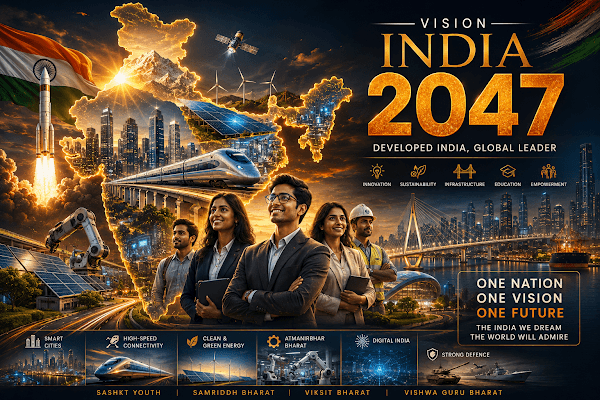
On 15 August 2047, India will celebrate the 100th anniversary of its independence.
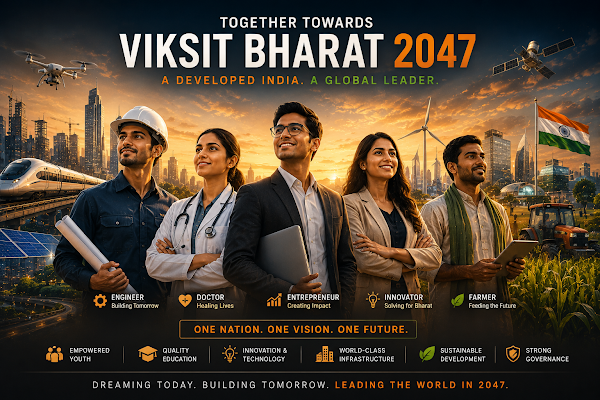
The government has set a goal called Viksit Bharat 2047: a developed India with high incomes, world-class infrastructure and a better standard of living for everyone. It sounds inspiring. But every ordinary citizen asks the same question: “Will it actually happen?”
This article answers that question without cheerleading or cynicism. We use published data from the IMF, World Bank, Economic Survey and other sources, and show both the progress and the gaps.
The Central Idea
- Viksit Bharat 2047 aims for a high-income, developed India by the 100th year of independence. NITI Aayog’s approach paper describes a roughly $30 trillion economy.
- India’s economy is around $4 trillion, but per capita income (about $2,880 per IMF) is a small fraction of the World Bank’s high-income line (about $14,000).
- The Economic Survey 2024-25 says roughly 8% average real growth for one to two decades would be needed.
- Jobs, education quality, health spending and research are the biggest gaps. The answer is “possible, but only with sustained high growth and reforms”.
What Is Viksit Bharat 2047? A Simple Explanation
Viksit Bharat 2047 is the government’s long-term vision to make India a developed country by 2047, the 100th year of independence. There is no single official definition of “developed”, but these benchmarks are commonly used:
- High-income status: the World Bank classifies countries above roughly $14,005 per capita income (2024-25 line) as high income, compared with about $2,880 for India (IMF, 2025)
- Human development: a Human Development Index above 0.8 is “very high”. India’s HDI is around 0.69 (UNDP)
- Strong institutions: rule of law, low corruption and efficient governance
- Public services: accessible healthcare and quality education
- Modern infrastructure: roads, rail, ports, power and internet
Figures as reported by the IMF, World Bank, NITI Aayog and the Economic Survey. GDP rankings and estimates change with each data revision, so check the latest releases.
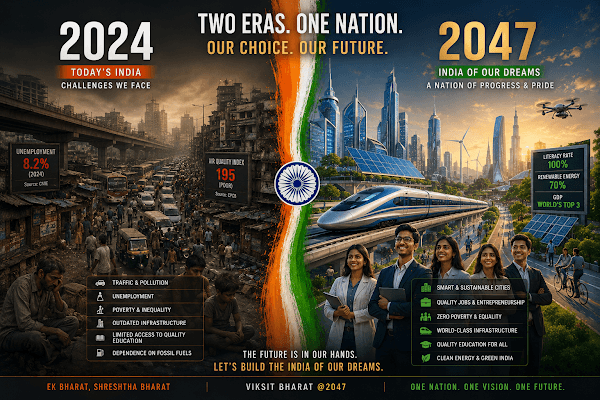
5 Themes Behind Viksit Bharat 2047
The government’s stated priorities can be grouped into five broad themes. This grouping is NXTBHARAT’s own summary, not an official list:
Free Tool: How Much Growth Does Viksit Bharat 2047 Need?
Try your own assumptions. The simulator shows the yearly growth needed to reach high-income status by a target year, and when India gets there at the growth rate you choose.
Is It Possible? What the Data Says
Now the honest part. Here is what is working, and what is still holding India back.
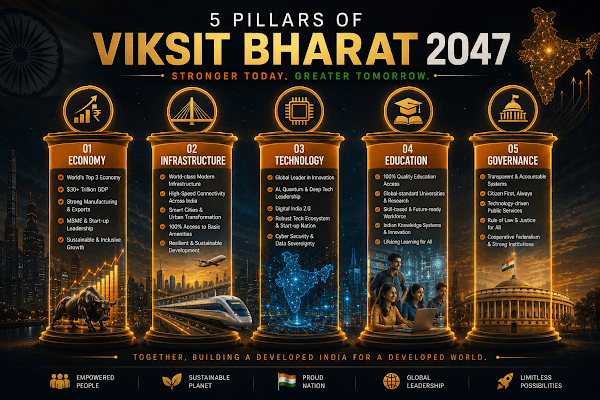
What is working
- Growth momentum: India is among the fastest-growing large economies, with forecasts generally in the 6-7.5% range. Over 21 years, compounding makes this powerful
- Digital public infrastructure: UPI, Aadhaar and DigiLocker are widely studied as models for other countries
- Manufacturing push: electronics assembly, semiconductor projects and “China Plus One” supply-chain shifts are bringing new investment
- Space and energy: Chandrayaan-3 landed successfully in 2023, and India targets 500 GW of non-fossil power capacity by 2030
- Falling poverty: a NITI Aayog discussion paper estimated that about 24.8 crore people exited multidimensional poverty between 2013-14 and 2022-23
What is still holding India back
- Jobs: youth unemployment is much higher than the overall rate, and many workers are in informal, low-paid work. See our analysis of unemployment in India
- Education and skills: enrolment has expanded, but employability surveys keep pointing to a large skills gap
- Inequality: the World Inequality Lab estimated the top 1% held about 40% of national wealth in 2022-23
- Health spending: public health spending is around 2% of GDP, well below what most high-income countries spend
- Research and innovation: India spends roughly 0.65% of GDP on R&D, compared with about 2.5% in China and 3.5% in the US
Lessons From Other Countries That Grew Fast
No country develops overnight. Here is how other fast-growing economies compare:
| Country | Rapid Growth Began | Outcome | Key Drivers |
|---|---|---|---|
| South Korea | 1960s | Reached high-income status by the 1990s, roughly 30-35 years | Export manufacturing, education, industrial policy |
| Singapore | 1965 (independence) | High income within about three decades | Trade, governance quality, skills |
| Japan | Post-war 1950s | High income by the 1970s | Technology, exports, high investment |
| China | 1978 reforms | Upper-middle income since about 2010; not yet high income | Manufacturing scale, infrastructure, exports |
| India | 1991 reforms, faster since 2000s | Lower-middle income today | Services, digital, growing manufacturing |
Approximate timelines; exact classification dates vary by source and income threshold.
Your Role in Viksit Bharat 2047
National development is not only a government job. Here are four practical ways individuals matter:
01 Invest in your skills
A skilled workforce is the foundation of growth. See our guide to the top 10 skills Indians need before 2030.
02 Be tax compliant
About 8 crore income tax returns are filed each year, although many filers owe no tax. A wider and honest tax base gives the state more room to fund roads, schools and hospitals.
03 Support domestic production where it makes sense
When quality and price are comparable, choosing Indian-made products supports local manufacturing jobs. It should never come at the cost of quality or fair competition.
04 Ask for results, not just promises
Healthy democracies need informed citizens who read the data, compare claims with outcomes and hold leaders of every party accountable.
Viksit Bharat Myths vs Reality
- “GDP size alone makes a country developed.”
- Size is not the same as income per person. India has a large economy but a low per capita income.
- “It will happen automatically if growth continues.”
- Growth must be sustained and broad-based. Jobs, skills and health matter as much as headline GDP.
- “It is impossible; India is too poor and too big.”
- It is hard, but several economies have made similar jumps. The question is how many years and how much reform it takes.
Final Verdict: A Real Possibility, With Conditions
Is Viksit Bharat 2047 possible? Possibly, but only with sustained high growth and major reforms.
The economy is large and growing. Digital infrastructure is a real strength. A young population can be an advantage if jobs and skills keep pace. But raising per capita income about five-fold in 21 years, improving education and health, and reducing inequality would be a historic achievement.
Use the simulator, read the data and decide for yourself. The path to 2047 is built by policy and by millions of individual choices.
Also Read
India vs China Economy: Who Is Ahead and Why?
Unemployment in India 2026: 7 Real Causes and Possible Solutions
Top 10 Skills Indians Need Before 2030: AI Era Career Guide
Frequently Asked Questions About Viksit Bharat 2047
Sources and Further Reading
Data is revised often, so check the latest releases.
- Economic Survey 2024-25 Growth of about 8% needed for Viksit Bharat. Visit Economic Survey.
- IMF World Economic Outlook GDP and per capita income estimates. Visit IMF.
- World Bank income classification High-income threshold. Read the methodology.
- NITI Aayog Viksit Bharat approach paper and multidimensional poverty discussion paper. Visit NITI Aayog.
- NITI Aayog CEO on India as the fourth largest economy (Outlook Business) Reported IMF figures and the $30 trillion aspiration. Read the report.
- UNDP Human Development Report India’s HDI. Visit UNDP HDR.
- World Inequality Lab Wealth concentration estimates. Visit WID.
Editorial note: The five themes, the lessons table and the simulator’s compound-growth model are NXTBHARAT analysis, not official data. Rounded figures are approximations. This article is general education and does not endorse any political party.