
Taxes · Budget 2026-27 · Explained Simply
Here it is in one line: of every ₹100 the Centre spends, ₹20 goes to interest on old loans, ₹22 goes to state governments and ₹11 goes to defence.
In the next three minutes you will follow one rupee on its full journey, build your own tax receipt, and learn five facts that most people get wrong.
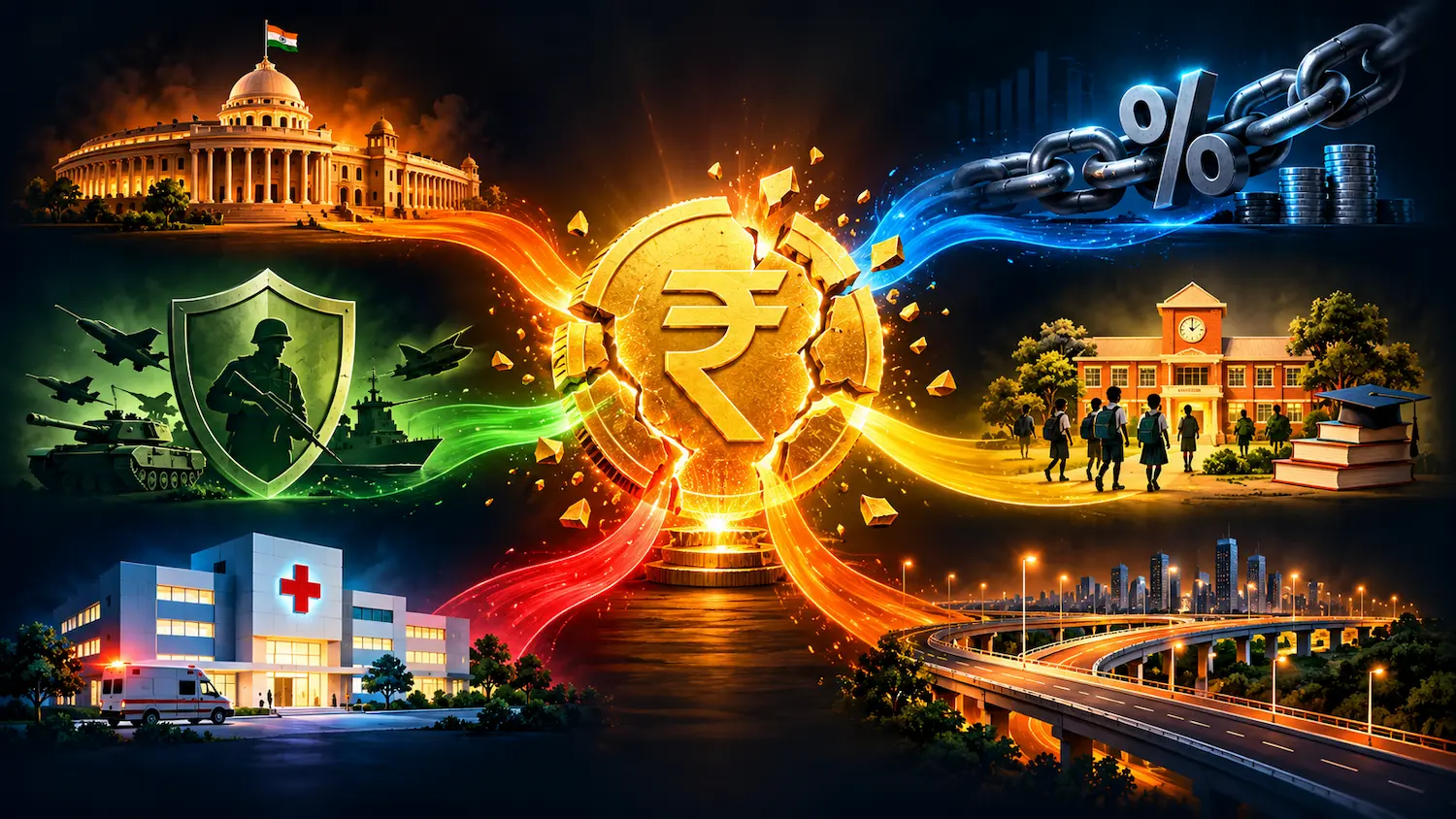
The 30-Second Answer to Where Does Tax Money Go
- ✅ The Centre expects 64 paise of every rupee from taxes: income tax 21 paise, corporation tax 18 paise and GST 15 paise.
- ✅ Another 24 paise comes from borrowing, so taxes alone do not cover the bill.
- ✅ The biggest spends are states (22 paise), interest (20 paise), central schemes (17 paise) and defence (11 paise).
- ✅ Most taxes go into one common pool, and Parliament decides how to spend it. No tax is tied to one road or one school.
- ✅ These are Union Budget 2026-27 estimates, not final figures.
First, Where Does Tax Money Come From?
Picture the government’s money as a single ₹1 coin. Here is how that coin fills up.
The last 2 paise come from non-debt capital receipts. Source: Union Budget 2026-27, Budget at a Glance, as reported.

So, Where Does Tax Money Go? 5 Shocking Facts
Now the spending side. So, where does tax money go, in order of size?
The last 15 paise: 7 paise other expenditure, 6 paise subsidies and 2 paise civil pensions.
Fact 1: Interest takes almost as much as income tax brings in
Think of it as the nation’s EMI. Past loans must be paid back with interest every year, and in 2026-27 that costs about 20 paise of every rupee. Income tax brings in 21 paise. So the interest bill is nearly the size of the entire income tax collection.

Fact 2: Your tax does not stay in Delhi
The single biggest slice, 22 paise, goes straight to state governments as their share of central taxes. Another 7 paise flows through Finance Commission and other transfers. States run much of the daily machinery you actually see, such as police, hospitals and schools.
Fact 3: Central schemes get more than defence
Defence gets 11 paise. Central sector schemes get 17 paise, and centrally sponsored schemes, which the Centre shares with states, get another 8 paise. Together, schemes receive 25 paise.
Fact 4: Subsidies and pensions are smaller than most people think
Many people assume subsidies swallow the budget. In the 2026-27 estimates, major subsidies take 6 paise and civil pensions take 2 paise. Interest costs more than both combined, several times over.
Fact 5: Your tax is not tied to anything
Most taxes flow into one common pool, called the Consolidated Fund of India. Parliament then approves how the money is spent through the Budget. So the income tax you pay is not set aside for one road or one school. It is mixed into the pool, and every rupee is spent as the whole Budget decides. So where does tax money go in practice? Into one pool first. Some special levies can work differently.
Your Tax Receipt: See Where Your ₹50,000 Goes
Paid ₹50,000 in tax this year? So, where does tax money go from your own pocket? If your money were split exactly like the whole Budget, this is the receipt you would get. To make your own, multiply your tax by the paise share, for example your tax times 0.22 for the states’ share.
Your ₹50,000 Tax Receipt (Illustration)
- State governments: ₹11,000
- Interest on past loans: ₹10,000
- Central sector schemes: ₹8,500
- Defence: ₹5,500
- Centrally sponsored schemes: ₹4,000
- Finance Commission and other transfers: ₹3,500
- Other expenditure: ₹3,500
- Subsidies: ₹3,000
- Civil pensions: ₹1,000
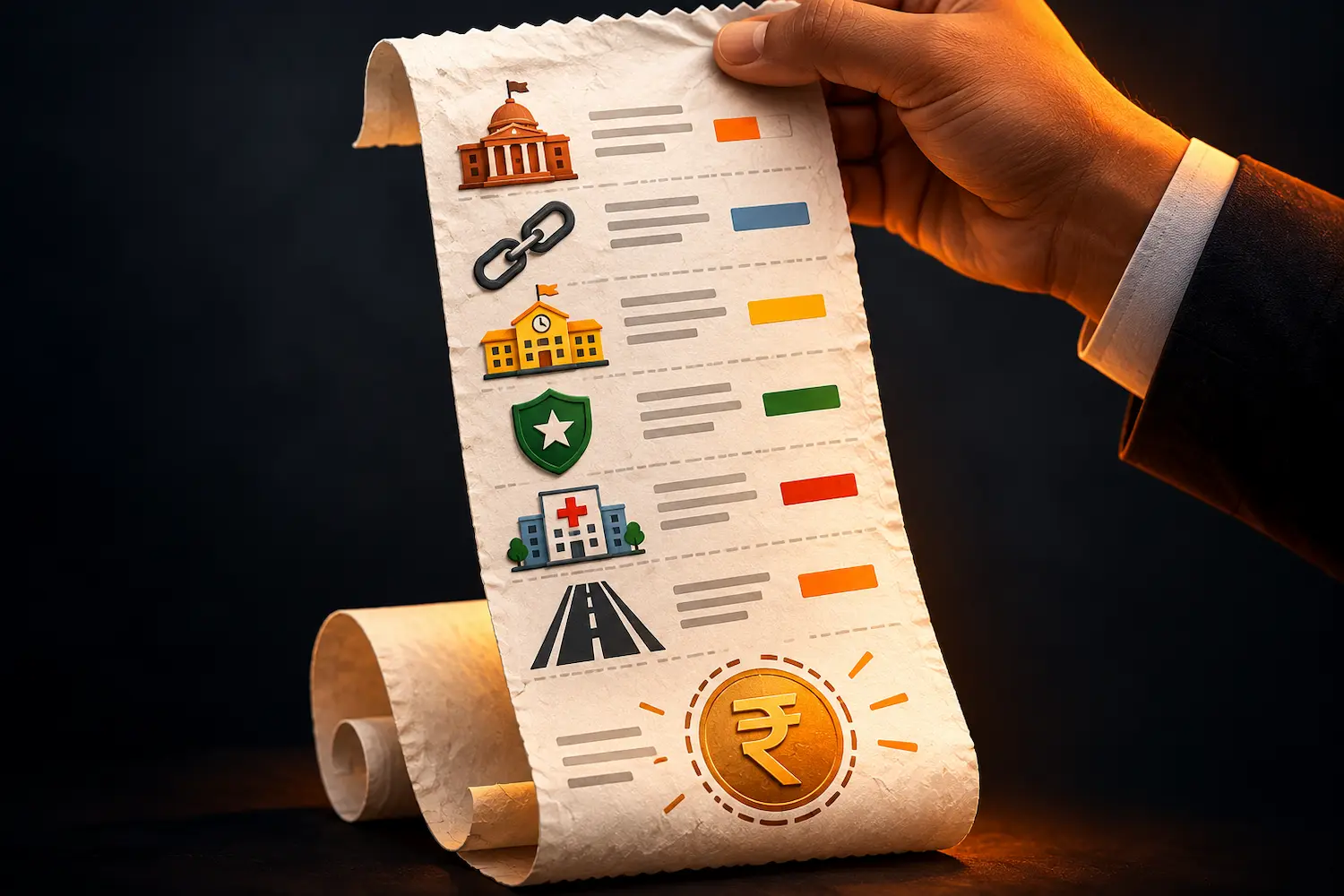
The Taxes You Pay Without Noticing
Income tax is the tax you see on your payslip. Most of the tax you pay, you never see. Before you ask where does tax money go, it helps to know which taxes you pay.
Direct taxes: you feel them
- Income tax, paid on personal earnings
- Corporation tax, paid by companies on profits
Indirect taxes: you barely notice them
- GST, built into the price of many things you buy
- Excise duty on certain goods, and customs duty on imports
State and local taxes
- Property tax, stamp duty on property deals and road tax on vehicles
- State taxes on items such as fuel and liquor
Even your insurance cost changed recently. Individual health and term life premiums have had 0% GST since 22 September 2025, which we explain in our guide to the must have insurance plans.
What Do You Actually Get Back?
Where does tax money go in the end? Into a pool that funds highways, railways, defence equipment, welfare schemes, healthcare, education and digital infrastructure. It also pays the salaries and pensions of government employees, which is one reason people compare government and private careers, as we did in our post on Sarkari Naukri vs private jobs.
Is the System Fair? Two Sides of the Story
Where does tax money go is a question of fact. Whether it is spent fairly is a matter of debate.
- The share of direct taxes is rising as incomes grow and more of the economy becomes formal
- Capital spending is going up
- The fiscal deficit target falls to 4.3% of GDP from 4.4%
- Debt-to-GDP is budgeted to ease to 55.6% from 56.1%
- Interest still takes 20 paise of every rupee spent
- Borrowing still funds 24 paise of every rupee
- Indirect taxes are paid by everyone, whatever their income, which some economists see as a heavier burden on poorer households
- Questions remain about how well schemes deliver on the ground
These are the main arguments each side makes. Both have data behind them, so judge for yourself.
Where Does Tax Money Go? Check It Yourself in 3 Minutes
Step 1: Read the official numbers
The “Budget at a Glance” document on the official Union Budget website shows the rupee coming in and going out, in simple charts.
Step 2: Check your own tax
Log in to the Income Tax e-filing portal and open your Annual Information Statement (AIS) or Form 26AS. It shows the tax deducted from your income.
Step 3: File on time
File your return before the deadline and keep your records. Late filing can lead to penalties and interest.

Three Tax Myths, Cleared Up
People often get the answer to where does tax money go wrong. Here are three common myths.
- “Income tax pays for everything the government does.”
- Income tax brings in 21 paise of every rupee. Borrowing brings in 24 paise.
- “All my tax stays with the central government.”
- 22 paise of every rupee goes to states as their share, plus 7 paise through other transfers.
- “Only people who file income tax pay tax.”
- Almost everyone pays indirect taxes such as GST whenever they buy taxed goods and services.
Final Word: Know Where Your Rupee Goes
So, where does tax money go? Mostly to your state, to interest on old loans, to central schemes and to defence, with smaller slices for subsidies and pensions. And a quarter of the money the government spends is borrowed, not collected as tax.
Knowing where tax money goes does not change your bill, but it changes how you read every budget headline, every promise and every debate about fairness.
Next time you pay tax, remember the receipt. You are funding a pool, and the pool belongs to all of us.
Bookmark this page. Each February we will update it with the new Budget numbers.
Frequently Asked Questions: Where Does Tax Money Go?
Sources and Further Reading
The figures in this article are Union Budget 2026-27 estimates, as reported. Final numbers (revised estimates and actuals) can differ, so check the official documents for the latest.
- Budget 2026-27: how the government earns and spends every rupee (The Federal)
Rupee comes in, rupee goes out, including subsidies and pensions.
Read the report. - Taxes to bring in 64 paise of every rupee govt earns (Siasat)
Receipt and expenditure shares from the Budget documents.
Read the report. - Budget 2026: where every rupee is spent and where it comes from (ETV Bharat)
Non-tax revenue, central schemes and civil pensions.
Read the report. - How the rupee comes and goes in Budget 2026-27 (Basis Point Insight)
Total receipts and year-on-year changes in shares.
Read the analysis. - Union Budget 2026-27: growth and structural transformation (ICAI, The Chartered Accountant Journal)
Sources of revenue, committed expenditure and the rising share of direct tax.
Read the article. - Budget 2026 in numbers (Upstox)
Capital expenditure, fiscal deficit and debt-to-GDP.
Read the summary. - Union Budget 2026-27 analysis and highlights (Bankopedia)
Individual income tax relief and the new Income Tax Act, 2025.
Read the analysis. - Union Budget website, Ministry of Finance
Official Budget at a Glance and other documents.
Visit the website.
Editorial note: The ₹50,000 tax receipt is an illustrative calculation by NXTBHARAT that applies overall Budget shares to a sample amount, not a statistic. The five facts, the “national EMI” comparison and the two-sides summary are NXTBHARAT analysis. This article is for general education and is not personalised financial or tax advice, so consider speaking to a qualified tax professional for decisions about your own taxes.