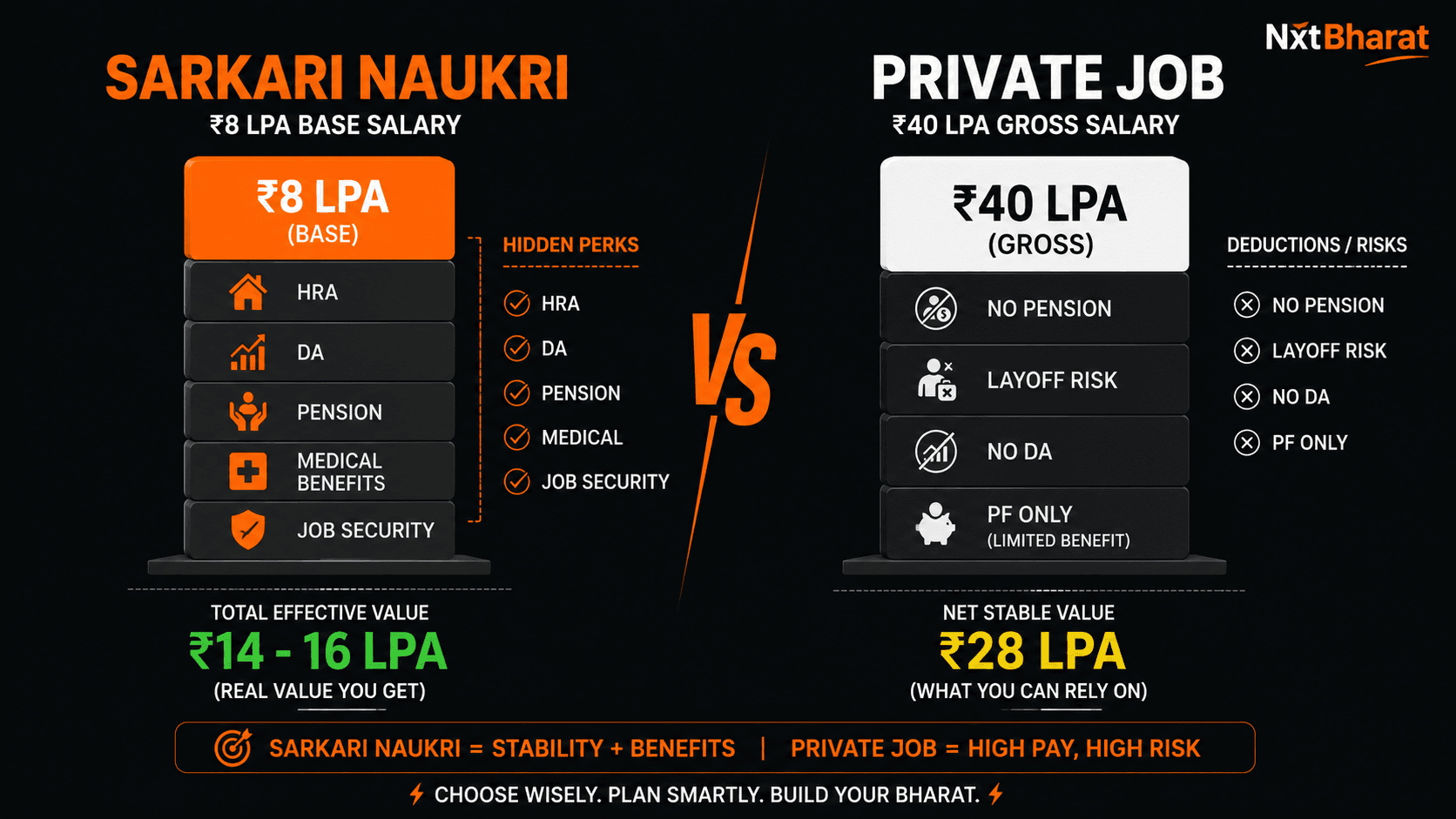
Government job vs private job: this debate happens in almost every Indian home. “Take the 8 LPA government job, it’s stable.” “No, take the 40 LPA private job, that’s where growth is.” The problem is that both sides oversimplify. Let’s look at the real picture, factor by factor.
Almost every engineering graduate, BA pass-out, or MBA holder in India faces the same question: government job vs private job? And it’s not only a career question. It involves family expectations, the fear of financial insecurity, “what will people say,” and 10 to 20 years of life planning.
Most articles either say “government jobs are best for stability” or “go private if you want growth.”Very few give an honest, India-specific comparison.
In this article we’ll do exactly that, comparing everything from salary to pension, from layoffs to promotions. At the end you’ll get a simple framework to decide based on your own situation.
⚡ Key Takeaways (If You Only Have 2 Minutes)
✅ Don’t compare CTC alone. Housing allowance, DA, health cover, pension and job security add real value to a government salary (the exact amount varies by post and city).
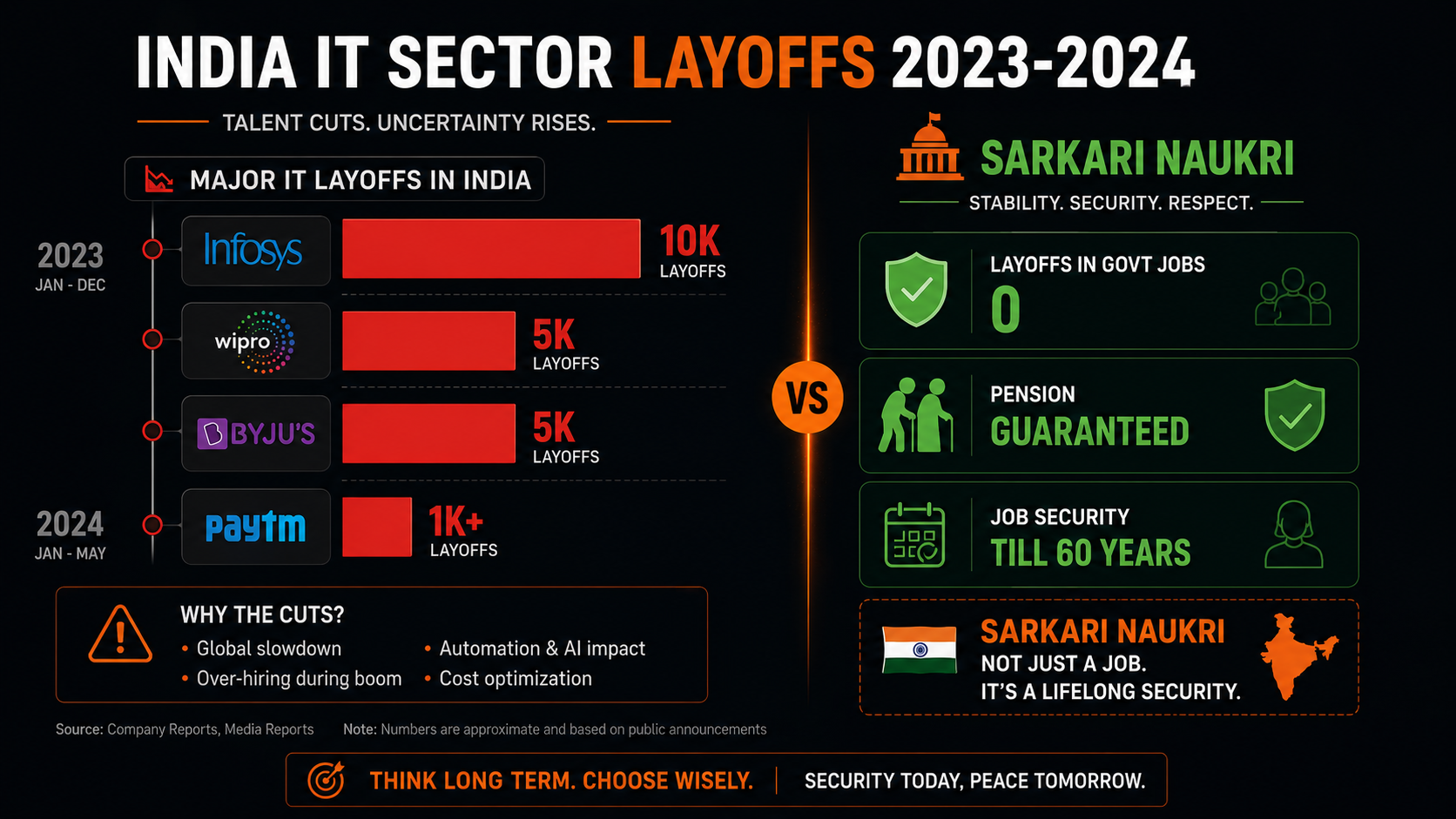
✅ Private jobs can pay far more, but job security is lower. The 2023-24 wave of tech layoffs showed this clearly.
✅ Preparing for government exams often means 1 to 5 years or more with little or no income, so the opportunity cost is real.
✅ Retirement security is a major government advantage. Private employees must build their own retirement corpus.
✅ There is no single right answer. It depends on YOUR risk profile, family situation and skills.
Look Beyond Salary: What Really Matters
Most people compare only the CTC. That’s the wrong approach. A real comparison looks at total compensation, stability, and career ceiling together.
Till 60
Typical retirement age for permanent central government employees
1-5 yrs
Typical preparation time for competitive government exams, depending on the exam
2023-24
Large tech layoff wave that affected many Indian and global companies
💡 Key insight most people miss: A government officer earning 8 LPA can be in a financially stronger position than the number suggests. Add housing allowance, DA increases, subsidised healthcare, pension benefits and the value of job security, and the gap with a higher private salary narrows. Comparing only CTC is a beginner’s mistake. The exact gap depends on the post, the city and the company.
Government Job vs Private Job: Head-to-Head Comparison (8 Factors)
This is the comparison job portals rarely show you. Real factors, no bias.
Factor
🏭 Government Job
🏢 Private Job
Winner
Starting Salary
Fixed by pay level and grade
Varies widely, higher for in-demand skills
Private (for skilled candidates)
Job Security
Very high for permanent posts
Lower, with layoffs and frequent job changes
🆕 Government
Retirement Benefits
Pension scheme (NPS/UPS-based, rules vary by employer)
EPF, plus whatever you save and invest yourself
🆕 Government
Medical Benefits
CGHS or state health schemes, often covering the family
Employer insurance, which usually ends with the job
🆕 Government
Career Growth Speed
Mostly seniority-based, so slower
Performance-based, so potentially faster
Private
Work-Life Balance
Generally more predictable hours
Often demanding, depends on company and role
🆕 Government
Skill Development
Can be limited and role-specific
Strong industry exposure
Private
Wealth-Building Ceiling
Salary is structured and capped
High, if you keep growing and investing
Private
⚖️ Score: Government wins 4 of 8 factors and private wins 4 of 8. On paper it’s a genuine tie. The factor that matters most in your life decides the winner.
40 LPA vs 8 LPA: The Debate Everyone Searches For
A very popular question on Google is: “Which is better, a 40 LPA private job or an 8 LPA government job?” The question itself shows how we compare extremes. Let’s be honest about it.
📊 A 10-Year Illustrative Scenario: Who Is More Comfortable?
Profile
🏭 Ramesh, SSC CGL Officer
About 8 LPA plus allowances. Posted in Delhi.
Profile
🏢 Suresh, IT Company, Bengaluru
About 40 LPA. Benefits mostly limited to PF and insurance.
Monthly In-Hand (approx.)
Roughly ₹55,000-60,000
Including allowances. DA is revised periodically.
Monthly In-Hand (approx.)
Roughly ₹2.3-2.5 lakh after tax
But rent in Bengaluru can take a big share
Medical Emergency
Health scheme may cover most costs
Coverage depends on the scheme and hospital
Medical Emergency
Covered while employed
A gap appears if the job ends, unless he has a personal policy
Job Status at Year 10
Same service, a few promotions
Very low layoff risk
Job Status at Year 10
Likely several job changes
Possibly a gap between jobs
Wealth Potential
Steady, built on a stable base
Depends on how much he invests
Wealth Potential
Higher, if employed continuously
Needs consistent investing and no long income gaps
Stress Level (typical)
Low to medium
Predictable work and life
Stress Level (typical)
Medium to high
Performance pressure and job anxiety
This is an illustrative example. Actual figures vary with city, tax regime, deductions and company.
Conclusion from this scenario: Suresh (40 LPA) can build more wealth, but ONLY IF he stays employed, invests well, and avoids a long income gap. Ramesh (8 LPA) builds wealth more slowly but on a very stable foundation. It’s a trade-off between compounding and stability.
What Nobody Tells You: Hidden Costs on Both Sides
🏭 Government: Hidden Costs
Years of exam preparation with little or no income
Postings anywhere in India, often far from family
Slow promotions can cause frustration
Limited skill exposure makes a career pivot harder
Bureaucracy and slow processes
Pressure or politics in some departments
🏢 Private: Hidden Costs
No guaranteed pension, so you fund your own retirement
Medical insurance may end with the job
Metro city rent can eat a large share of salary
A layoff gap means no income but ongoing EMIs
Constant reskilling and burnout risk
Higher tax brackets at higher salaries
The ONE Thing That Decides: Your Risk Tolerance
After all the analysis, one thing matters most: your risk tolerance and family situation. This isn’t a motivational line. It’s practical reality. Check yourself against these points:
Family financial dependence: If parents, siblings or a spouse depend on your income, stability should come first, which favours government jobs.
City preference: If you plan to live in a tier-1 city, a private job’s salary premium can offset higher living costs. In tier-2 and tier-3 cities, a government job often stretches further.
Skill demand: In-demand skills such as data, AI/ML, cloud and finance reduce your layoff risk in the private sector.
Stress sensitivity: If performance pressure and job uncertainty affect your mental health heavily, a government job may suit you better.
Side income or business plans: If you want to build a business or freelance income, private-sector skills and networks are often more transferable.
💡 NxtBharat Insights: 5 Things Most Articles Skip
Practical observations with India-specific context
📈
The 8th Pay Commission Could Raise Government Salaries
The 8th Pay Commission process is underway. Past pay commissions have brought meaningful increases, but the timing and size of the next revision are not final, so check official announcements before relying on any number.
🤖
AI and Automation Affect Private Jobs First
AI is expected to change routine, repetitive white-collar work, though the scale and speed are still debated. Government jobs are less exposed in the short term because staffing decisions are policy-driven, but no sector is completely untouched.
🏠
Loans Can Be Easier for Government Employees
Because of stable income, banks often see government employees as lower-risk borrowers, which can mean smoother approvals and sometimes better terms. Compare offers from several banks, as terms vary.
⚖️
Private Job + Side Income = A Strong Combination
One powerful strategy in 2026 is to take a private job for the salary while building a skill-based side income. If a layoff comes, the side income acts as a safety net, giving you some of the stability of a government job along with private-sector growth.
🎓
Calculate the Opportunity Cost of Exam Preparation
If you spend 3 years preparing and could have earned ₹6 LPA in a private job, that’s roughly ₹18 lakh of income plus work experience that you give up. This cost is rarely discussed, but it is real. If you do prepare, have a backup plan.
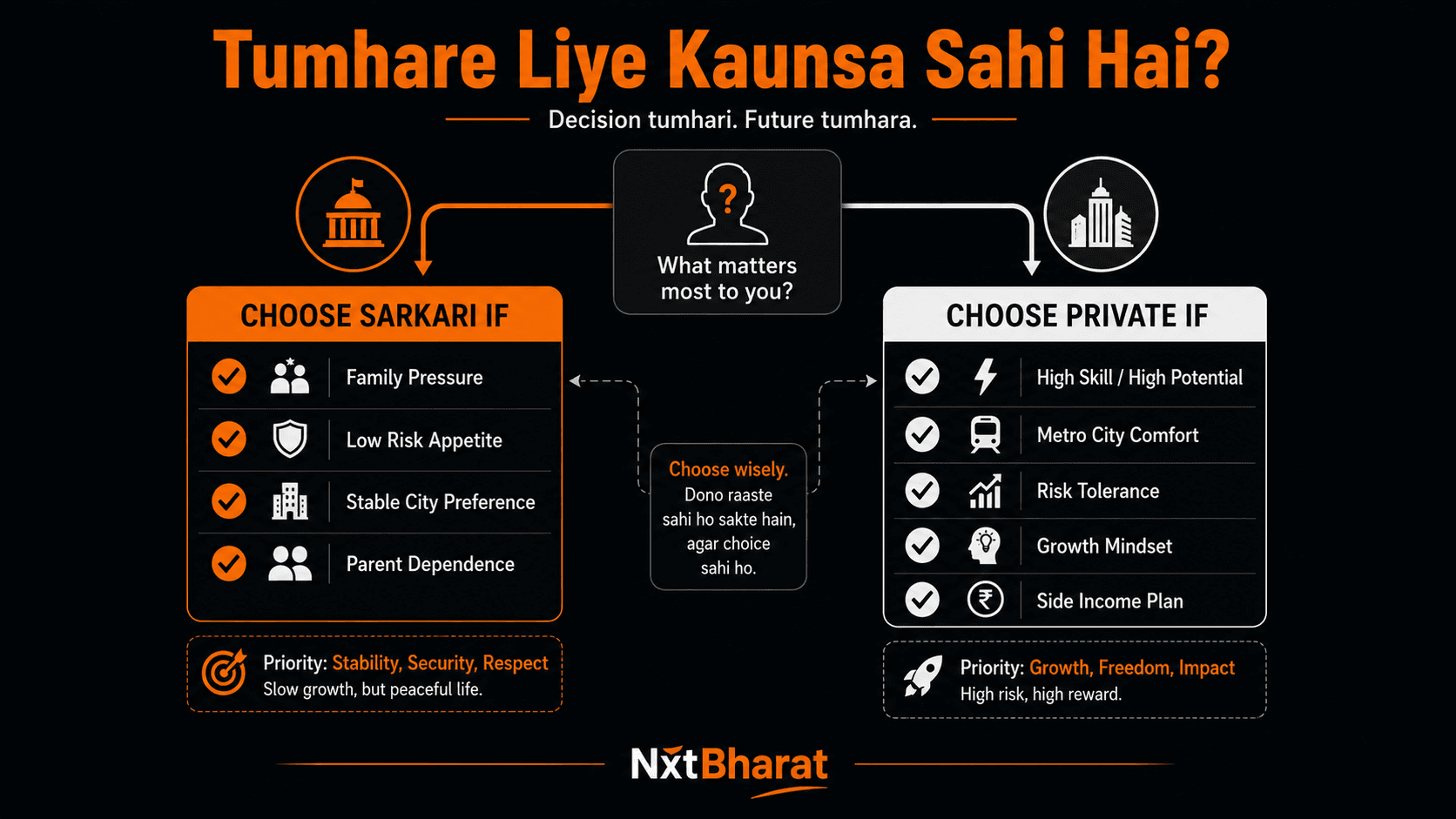
Final Decision Framework: Which One Is Right for You?
An honest answer: one size doesn’t fit everyone. Check your situation against the points below.
🏭 Choose a Government Job If
Your parents depend on you financially, or will, so stability is non-negotiable
You are comfortable living in a tier-2 or tier-3 city
Uncertainty makes you anxious and your mental health is a priority
Long-term pension and retirement security matter most to you
A government exam is realistic in your field (UPSC, SSC, banking, state PSC)
You have financial support for 2 to 3 years of preparation
🏢 Choose a Private Job If
You have a high-demand skill in tech, finance, data, design or management
You are ready to live in a metro city and can manage the cost
Your risk tolerance is high and you can survive a gap between jobs
You plan to build a side income or business as a safety net
Fast career growth and wealth building matter more to you than stability
You enjoy continuous learning and upskilling
🔗 Connect the dots: If you’re still confused after graduation, read 10 Mistakes to Avoid After Graduation first. It lays the foundation for career planning, and this comparison will make more sense afterwards.
Final Word: Both Are “Best,” Depending on Your Situation
If you remember only one line from this article, make it this: A government job is the best tool for stability. A private job is the best tool for wealth building. Both are tools, and the right one depends on your problem.
People who spend 5 to 7 years preparing for a government exam without a backup plan are taking a big risk. People who rely only on a private salary, with no emergency fund or side income, are taking a big risk too.
The smart move in 2026: Take a private job, build a side income, invest regularly, and keep an emergency fund. Or: Prepare for a government exam, earn part-time during preparation, and invest once you qualify.
A career is a tool. Use it to build wealth. 🎯
Frequently Asked Questions
1. Which is better in India in 2026: a government job vs private job?
There is no universal answer. A government job offers stability, retirement benefits, subsidised healthcare and very low layoff risk. A private job offers higher pay potential, faster growth and greater wealth-building potential. The right choice depends on your risk tolerance, family situation, skills and preferred city. Use the checklist in this article to decide.
2. Which is financially better: an 8 LPA government job or a 40 LPA private job?
Comparing CTC alone is misleading. For a government employee, add housing allowance, DA, healthcare and the value of job security. For a private employee, subtract higher tax, metro rent and the lack of a guaranteed pension. The gap narrows, but a 40 LPA salary can still build more wealth if you stay employed and invest consistently. Over 10 years, the government employee’s income is more predictable.
3. How secure are private jobs in India in 2026?
Security varies by sector and skill. The tech industry saw a wave of layoffs in 2023-24, and many professionals change jobs every few years. People with high-demand skills generally find new roles faster. Permanent government jobs, by comparison, rarely involve involuntary layoffs.
4. Is preparing for government exams a waste of time?
It depends on the exam and your discipline. Some exams can be cleared in 1 to 2 years, while others like UPSC can take longer. The opportunity cost is real, because you could have been earning during that time. But if you succeed, you get long-term stability and benefits. Always keep a backup plan or some income source instead of preparing with no safety net.
5. How can I build wealth with a private job in India?
A high salary builds wealth only if you invest. A common rule is to invest a fixed share of your salary (for example 20%) in SIPs as soon as it arrives, keep a 6-month emergency fund, build a side income, and invest in high-demand skills to reduce layoff risk. Consider speaking to a registered financial advisor for your specific case.
6. Is a government job better for marriage and family expectations in India?
In many families, especially in smaller cities, a government job carries extra social value. In practice, a well-paid and stable private career is increasingly respected too, particularly in big cities. Financial stability usually matters more than the type of job.
7. How will the 8th Pay Commission affect government salaries?
Past pay commissions have led to meaningful salary increases, but the size and timing of the 8th Pay Commission’s revision are not final. Check official government announcements for the latest. In general, pay revisions in government jobs come through the commission system, while private employees negotiate raises through performance and job changes.
8. How big a threat is AI to private-sector jobs in India?
The threat is real but uneven. Routine, repetitive tasks such as data entry, basic customer support and simple analysis are more exposed. Roles that need judgment, creativity, relationships or deep expertise are less exposed for now. Private-sector workers will need to reskill continuously, while government jobs are less exposed in the short term because of how staffing decisions are made.
Personal Finance · Insurance Guide · India 2026 Every family carries a few sleepless-night questions. What if someone falls seriously ill? What if the…