
India Economy · Technology · The Future
India writes software for global banks, airlines and retailers. Yet most Indians hold phones designed abroad, search on platforms built abroad and run on operating systems written abroad.
The gap can be summed up in one line: India sells its brains by the hour. Product nations sell their ideas by the million.
This post looks at why that gap exists, what the data says, and which five shifts could begin to close it.

The Central Idea
- Services made India’s tech industry famous. Products would make it owned.
- Nasscom estimates that software products are only about 7% of India’s $315 billion tech industry.
- Four barriers stand in the way: thin R&D funding, a culture that rewards safety, a shallow component base and too few first customers.
- Becoming a product based nation does not mean abandoning services. It means using them as a springboard.
Why India Is Not Yet a Product Based Nation
Imagine Arjun, a fictional engineer in Bengaluru. He builds features for a shopping app used by millions of people abroad. He is good at his job, and his salary covers the rent, an EMI and his parents’ medicines.
One evening he sketches a simple inventory app for neighbourhood kirana shops. Building it would mean savings, a co-founder and perhaps a year without a salary. At home, one question settles the matter: “Why risk a stable job for an idea?”
Arjun is fictional, but his dilemma is not. It shows how an entire economy behaves when services are safe and products are risky.
The national numbers show the same pattern. Nasscom’s FY26 estimates put India’s tech industry at about $315 billion. IT services account for roughly $149 billion of that, while software products account for about $23 billion. Exports are estimated at around $246 billion.
These are industry estimates, and the categories overlap, because some product work sits inside engineering and R&D services. Read them as a broad picture, not an exact split.
Even the services model is changing. Nasscom expects FY26 revenue to grow 6.1%, but net hiring of only about 135,000 people, similar to the year before. As automation lifts productivity, the safe ladder many graduates counted on is getting narrower. We explored that wider picture in our analysis of unemployment in India.
Service Nation vs Product Nation: What Actually Changes?
A product based nation does not look different because it writes less code. It looks different because of who owns the result.
- Paid for time and effort
- Revenue grows mostly as headcount grows
- The client often owns the finished work
- Margins are limited by wages
- The client carries the market risk
- Paid for the value of what is built
- Revenue can grow faster than headcount
- The builder owns the intellectual property
- Each extra customer costs relatively little
- The builder carries the risk, and the reward
This is not a case against services. The tech industry employs close to six million people, earns most of India’s tech exports and trained a generation of engineers. The smarter goal is to use that strength as a springboard, not to burn the bridge.
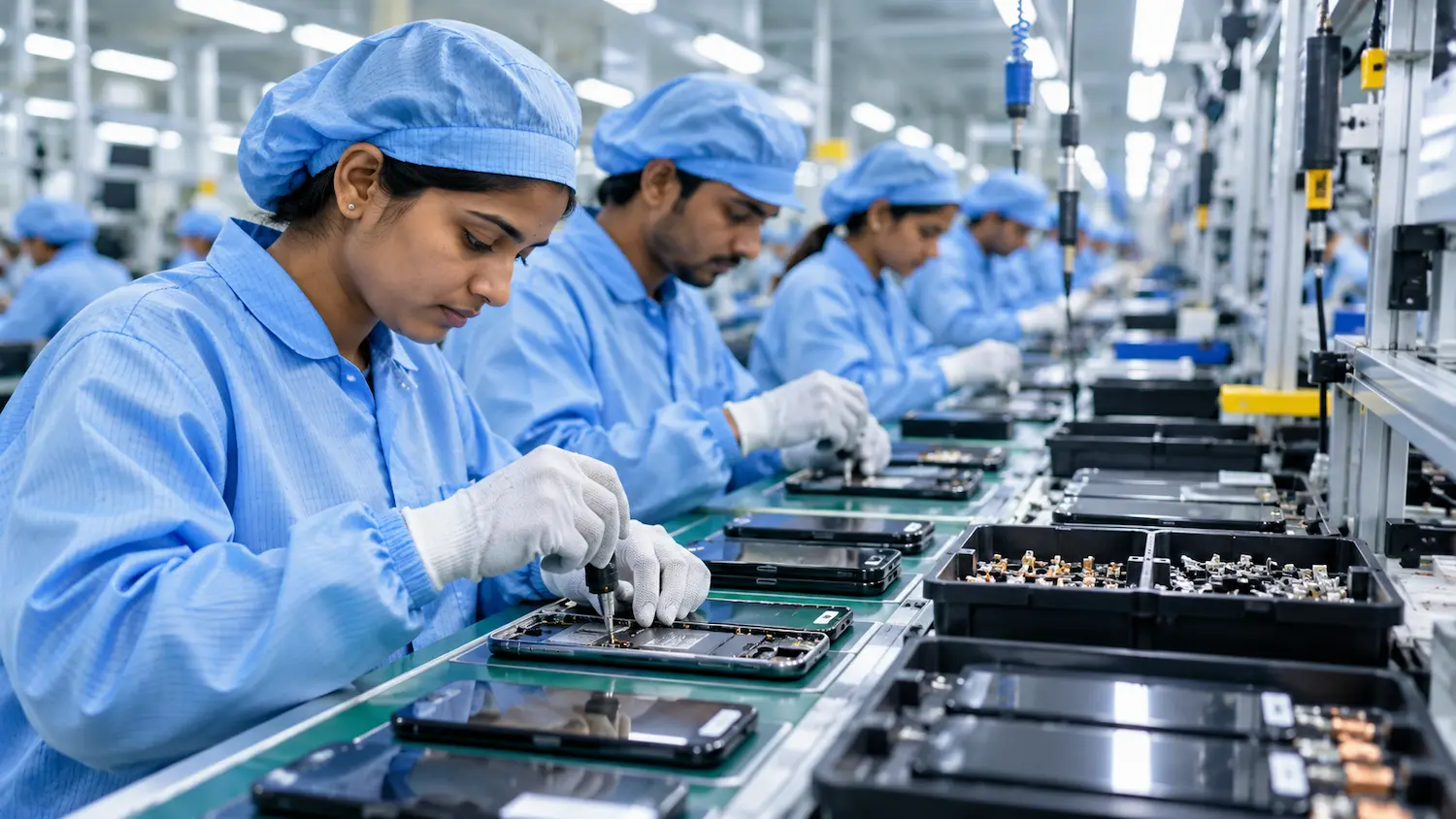
The Assembly Illusion: Making Phones Is Not Owning Phones
India’s electronics story is a real success. According to figures given to Parliament in July 2026, electronics production rose from about ₹1.9 lakh crore in 2014–15 to an estimated ₹13.11 lakh crore in 2025–26. Mobile phone exports reached roughly ₹2.6 lakh crore, and the sector supports around 25 lakh jobs.
But production value and ownership are different things.
The chairman of the India Cellular and Electronics Association (ICEA) has put domestic value addition in mobile phones at 18–20%, compared with 38–40% in China. Domestic components made up only about 9% of India’s electronics output in 2023–24, against roughly 42% globally in 2022. Displays, camera modules and chipsets, which are reported to make up more than half of a phone’s parts cost, still largely arrive from abroad.
The government has recognised the gap. A component manufacturing scheme worth ₹22,919 crore and a ₹76,000 crore semiconductor mission are meant to deepen the supply chain.
What Stops India From Becoming a Product Based Nation?
Talent is not the missing ingredient. India has engineers, researchers and founders in abundance. Three less visible walls stand between that talent and globally competitive products.
Wall 1: Patient money is scarce
India spent about 0.84% of GDP on R&D in 2023–24. Coverage of the Global Innovation Index 2025 reports China at about 2.4% and South Korea at about 4.9%, though the reference years differ.
There is encouraging news. Private industry now provides just over half of India’s R&D spending (₹1.27 lakh crore of ₹2.45 lakh crore), and India ranks 38th of 139 economies in the 2025 index. Researchers cited in that coverage point to one weak link: turning research into products.
Products also take years to earn their first rupee, while services pay from month one. Unless funding is patient, rational people choose the faster paycheque.
Wall 2: Safety is India’s most popular product
In many middle-class homes, a stable salary is the most successful “product” ever sold. It is easy to see why: a secure job protects a family from risk. But when almost every talented person optimises for safety, few are left to take the risks that create new products.
This is our analysis, not a statistic. It is the same trade-off we examined in our comparison of Sarkari Naukri vs private jobs in India.
Wall 3: Every product needs a first believer
A new product needs a buyer willing to try something unproven. In our assessment, large companies and public bodies often prefer established vendors. That is rational for them, but it leaves new Indian builders without the early customers they need to improve.

Proof That India Can Build Products at Scale
The best evidence that a product based nation is possible is already in your pocket. In September 2026, UPI processed 24.07 billion transactions worth ₹29.37 lakh crore, averaging about 802 million a day, according to NPCI data.
UPI worked because India designed for its own problem at its own scale. The world then took notice: NPCI’s international arm has signed an agreement to extend UPI merchant payments to Uzbekistan.
The pattern is worth copying: solve a problem at Indian scale first, then export the solution.
5 Shifts That Could Make India a Product Based Nation
1. Fund ideas for the long run
Raising R&D spending is the clearest lever. Experts have proposed targets of 1.5% to 2% of GDP, and tax incentives could encourage private firms to invest in products with long payback periods.
2. Move from assembling to owning
The next stage is components, chips and design. A country that only assembles remains dependent on whoever supplies the valuable parts.
3. Let the state be the first customer
Fair, transparent procurement that lets credible Indian products compete for public contracts would give founders the early revenue and feedback that private markets often withhold.
4. Make failure survivable
A nation gets as many great products as it can afford failures. Grants, easier shutdowns for failed ventures and a culture that treats a failed attempt as experience would lower the personal cost of trying.
5. Keep talent working on Indian problems
Talent that leaves often takes its first product with it. We covered that trend in our guide to India’s brain drain. Staying becomes more attractive when the best problems, funding and customers are here.

What You Can Do
Nations change when enough individuals change their choices. A few practical starting points:
- Students: build one small product, not just assignments. A working project teaches what a classroom cannot.
- Employees: look for product teams inside your company, and learn how a product is priced, sold and supported.
- Families: treat a well-planned risk as a career strategy, not a failure.
- Everyone: when an Indian product is genuinely as good, give it a fair first try. First customers help build a product based nation.
Final Word: From Hired Hands to Owned Ideas
A service nation is paid for effort. A product nation is paid for the idea.
India has proved it can do the first better than almost anyone, and UPI has shown it can do the second. The challenge now is to make that second ability ordinary instead of exceptional.
The goal is not to stop writing code for the world. It is to also build something the world pays to use.
Arjun’s inventory app may never be built. But if enough Arjuns find the money, the first customers and the safety net to try, India’s next chapter may look very different from its last.
Frequently Asked Questions
Sources and Further Reading
The statistics in this article refer to the periods and populations described. Some are estimates, and cross-country comparisons use different reporting years.
- Nasscom Annual Strategic Review, FY26 estimates
Tech industry revenue by segment, exports and net hiring.
Read the coverage. - R&D Statistics 2023–24 — Government of India (reported by ANI/The Tribune)
R&D spending, share of GDP and private-sector contribution.
Read the report. - Global Innovation Index 2025 — WIPO (coverage by The Wire)
India’s 38th rank and R&D comparison with China and South Korea.
Read the analysis. - Electronics production and exports, 2025–26 — Lok Sabha reply
Electronics and mobile phone production and export figures.
Read the report. - Domestic value addition in mobile phones
ICEA and government-linked reporting on value addition and PLI targets.
Read the report. - UPI transactions, September 2026 — NPCI data
Monthly volume, value and international expansion.
Read the report.
Editorial note: Arjun is a fictional, illustrative character and not a real person’s testimony. The three walls and five shifts are NXTBHARAT analysis, not statistics. Numerical claims are attributed to the reports cited above.