Career · Student Guide · Young India
Knowing what to do after graduation is not about having a perfect plan. It is about avoiding the mistakes that waste your first two or three years.
This guide covers the 10 most common career mistakes Indian graduates make, the fix for each one, and a simple 90-day action plan you can start this week.

Every year, millions of graduates in engineering, arts, commerce and science step out of college and into the same job market. The competition is real, and so is the skill gap.
According to the India Skills Report 2026, only about 56% of young Indians are considered job-ready, which means roughly four in ten still need extra training before employers will hire them. Many of them lose their first few years making avoidable decisions.
If you have just graduated, or are about to, read this once before you decide anything.
Key Takeaways
- The India Skills Report 2026 puts overall employability at 56.35%, so a skill gap is still real.
- Waiting only for a government job is the most common and most costly mistake.
- The first six months after graduation shape your career direction more than most people realise.
- In India, your network can matter as much as your marks, because many jobs are filled through referrals.
- Start a small SIP with your first salary. Time in the market beats the size of the amount.
Data snapshot, 2026. Employability scores come from a test-based study and are not the same as job placement or unemployment rates.
What to Do After Graduation: 10 Mistakes to Avoid
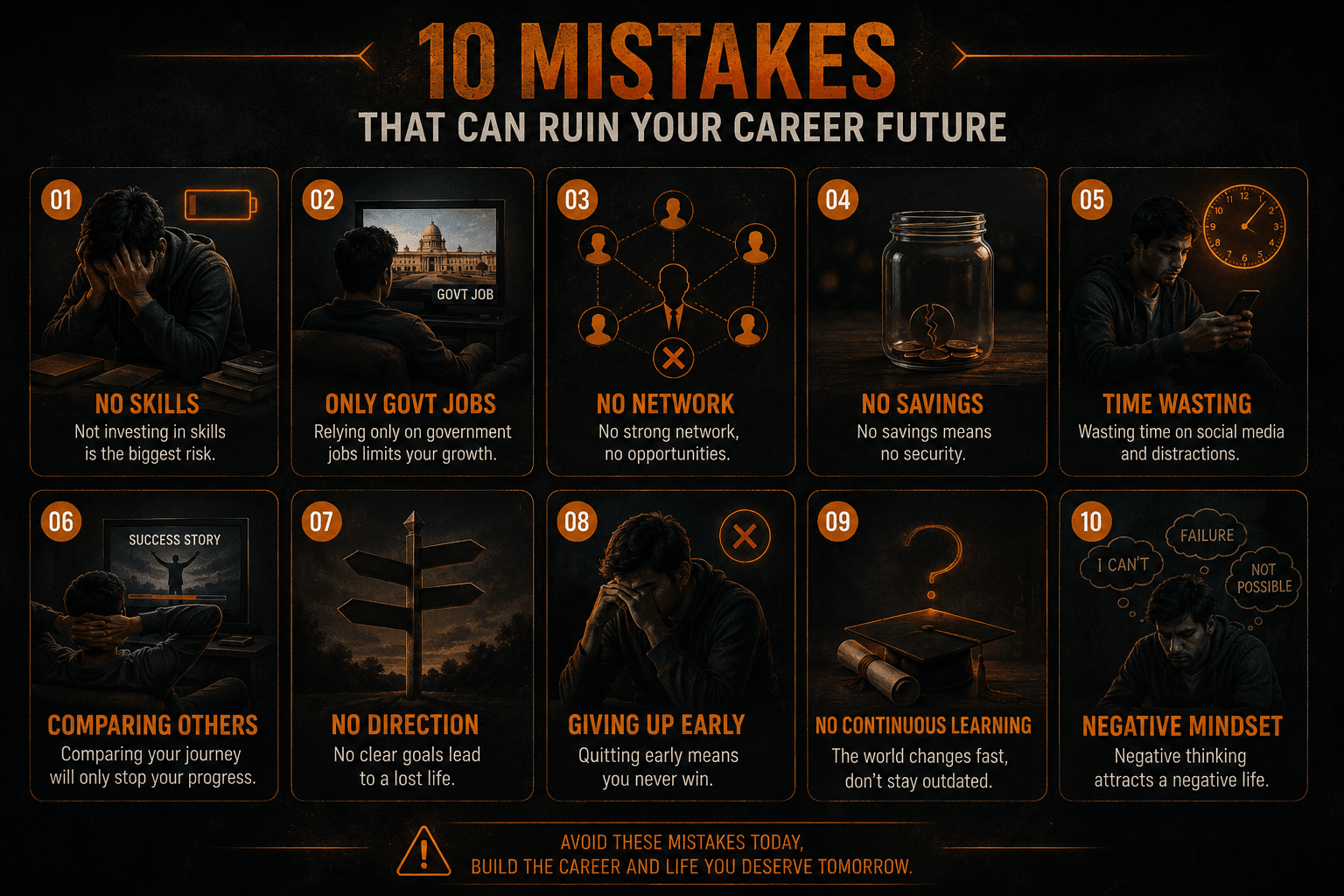
Before the action plan, here are the ten mistakes that hurt Indian graduates most, each with a practical fix.
Mistake 1: Waiting Only for a Government Job
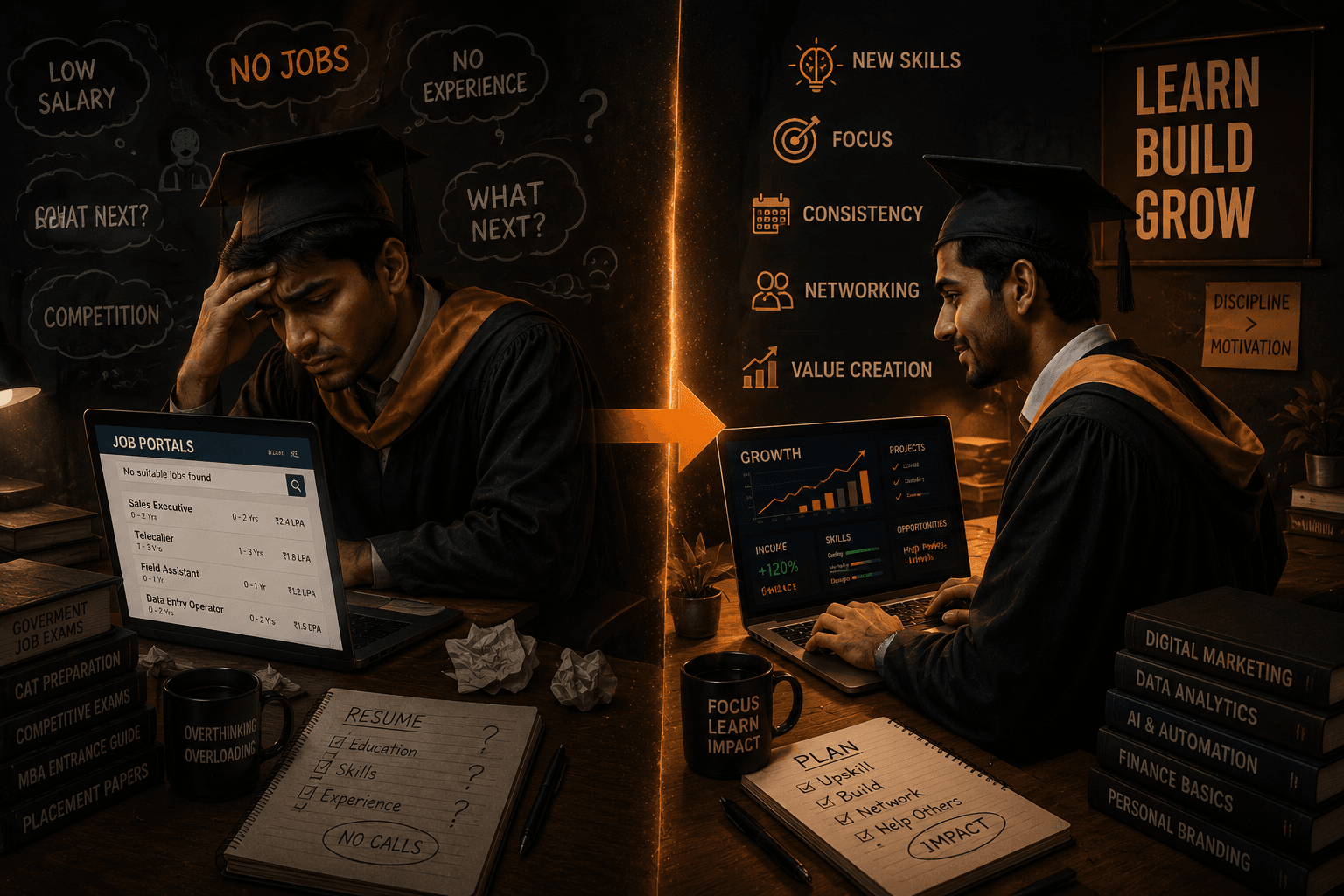
This is the most common trap. Many graduates spend two or three years preparing only for SSC, UPSC or state PSC exams and ignore the private sector completely.
The odds are steep. Roughly 10 lakh or more candidates apply for UPSC’s civil services exam each year, and only around 1,000 vacancies are filled. That is a selection rate of about 0.1%.
Mistake 2: A Resume That Is Only “Degree + Hobbies”
Most fresher resumes look the same: name, degree, CGPA and hobbies like reading and cricket. There are no projects, no internships and no proof of skill.
A recruiter scans a resume in seconds and asks one question: “Can this person do the job?” A degree does not answer that. Projects and experience do.
Mistake 3: No Network and a Blank LinkedIn Profile
Many jobs in India are never advertised widely. They are filled through referrals, and a referral only comes when someone knows you exist.
Graduates who only apply through job portals compete with thousands of other applicants. Those who reach out to people directly usually get far more conversations.
Mistake 4: Thinking the Degree Alone Is Enough
A BTech or BA today does not mean what it meant in 2010. AI, cloud and data analytics are still missing from many college syllabi, yet employers ask for them.
We have already covered the top 10 skills Indians need before 2030, and these are the skills recruiters are looking for. A degree opens the door, but skills get you through it.
Mistake 5: Choosing the First Job on Salary Alone
Fresh graduates often pick a higher-paying but stagnant job over a lower-paying role with real growth. What you learn in your first job shapes your next five years far more than the starting salary does.
Compare a ₹25,000 per month role that teaches in-demand skills with a ₹35,000 per month role that leaves you at the same level two years later. The first usually wins on long-term earnings.
Mistake 6: Putting Off Financial Planning
The first salary arrives and goes straight to a phone upgrade, clothes and restaurants. “SIP? Emergency fund? Let me settle down first.” This habit is exactly how the middle-class trap begins.
Here is an illustration. A ₹500 monthly SIP started at age 22 could grow to roughly ₹47 lakh by age 60, assuming a 12% annual return. The same SIP started at 32 could reach only about ₹14 lakh. A ten-year delay costs over ₹30 lakh. Returns are not guaranteed, but the pattern holds: time matters more than the amount.
Mistake 7: Treating Higher Education as the Default Option
“I don’t know what to do, so let me do an MBA.” For many Indian graduates, an MBA is an escape from confusion. Fees at many mid-tier colleges run into several lakhs, while average placement packages may not justify the cost.
Higher education makes sense when there is a clear reason, such as a specific career switch, a top-tier institute or specialised knowledge.
Mistake 8: The Comparison Trap
“Sharma ji’s son became an IAS officer.” Seeing peers succeed on social media pushes many graduates into panic decisions. A friend joins a startup, a cousin moves abroad, and suddenly you feel you must do the same.
In India the pressure is even stronger, because family, relatives and neighbours all offer opinions, and every opinion is different.
Mistake 9: Ignoring Soft Skills
Indian education focuses heavily on technical knowledge, while communication, presentation, leadership and negotiation get little attention. The result is brilliant engineers who struggle in meetings and smart graduates who fail interviews.
The World Economic Forum’s Future of Jobs Report 2025 lists analytical thinking, resilience and leadership among the skills employers value most. Soft skills are not a bonus. They are career-defining.
Mistake 10: Planning Forever and Never Acting
This is the biggest and most common mistake. People make plans, watch videos and read articles, but never do the actual work. “I’ll start tomorrow” becomes a trap.
Waiting for opportunities to arrive is one reason joblessness lasts longer than it should. You can read the full picture in our analysis of unemployment in India.
What to Do After Graduation: A 90-Day Action Plan
Knowing what to do after graduation is easier with a timeline. Follow this order and do not skip the early steps for the exciting ones.
Final Word: Mistakes Are Fine, Repeating Them Is Not
These ten mistakes are listed so you can recognise them in yourself or your friends. Recognition is the first step.
Competition in India is tough, but people who work with intention always stand out. If you are reading this, you are already ahead of those who are not looking for answers.
If you are unsure what to do after graduation, pick one action from the 90-day plan and do it today.
Start today. Start now.
Also Read
- Top 10 Skills Indians Need Before 2030: AI Era Career Guide
- Unemployment in India 2026: 7 Real Reasons and Possible Solutions
- The Middle Class India Trap: Why Higher Earners Still Don’t Get Rich
- Sarkari Naukri vs Private Job in India 2026
Frequently Asked Questions
Sources and Further Reading
Statistics refer to the periods and populations described. Rates and figures change every year, so treat them as a picture of the trend.
- India Skills Report 2026 (coverage by AffairsCloud)
Overall employability of 56.35%, up from 54.81% in 2025.
Read the report. - India Skills Report 2026 (coverage by Careers360)
Employability by degree: engineering, MBA, commerce and vocational streams.
Read the report. - World Economic Forum: The Future of Jobs Report 2025
Skills employers value most, including analytical thinking, resilience and leadership.
Read the report. - Union Public Service Commission (UPSC)
Official notifications on civil services vacancies and applicants.
Visit UPSC. - Zerodha Varsity
Free, beginner-friendly lessons on investing and SIPs.
Start learning.
Editorial note: The SIP figures are illustrative calculations by NXTBHARAT assuming a 12% annual return, and returns are not guaranteed. The ₹25,000 and ₹35,000 salary comparison is an example, not a statistic. The ten mistakes and the 90-day plan are NXTBHARAT analysis. This article is for general education and is not personalised financial or career advice. Investments are subject to market risk.